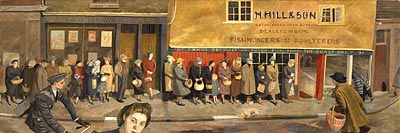
Reflection: on queues and queuing, across London and Lahore.
The difference of queueing systems and people in queues in different geographies and nations speaks for the mindset or mental structure of the people at large. I have absorbed and reflected on this tempramentality while observing people in queues across London and Lahore and other places. How does a space and a moment indicate the weight, curse or blessing of structures and infrastructures. The other day, there was a queue in the ladies’ room in a museum that has a lot of toilets, and it wasn’t a busy time of the day. I superseded the que-ers while explaining that I was going to check if all the toilets were occupied or not, upon checking, we realised that almost half of them were free and everyone took a sigh of relief! During the carnival in summer, there was a 3 minute long queue inside the underground tunnel in a central London station. From far away it appeared as if the staff had closed the sliding grilled door that led to the train, and we could not get our train until they opened it and gave us a signal. I bent down and snuck myself out of the rope barrier on our side and walked past everyone with the decision to exit the station and take alternative transport. Upon reaching the beginning of the queues, I asked a lady standing in the front if she thought the man standing in front of the shut grilled door was underground security staff. Upon being asked, she looked at me and the man looked back at both of us! The answer was in the exchanged silences, and we slid open the door… The entire queue was a farce. Many people had been waiting for more than an hour. No one questioned the sliding grilled shut door. The door and the man standing in front of it had created this illusion. In the museum where I work some exhibition entrances don’t have a certain curatorial direction but a crowd often gathers on the spot where the first person begins their viewing. The other side of the gallery remains empty. Today the area with the introductory wall text was empty while everyone was waiting to read the text on the other side.
In Lahore, it’s the opposite. Upon my first exposure to the so-called progressive world (USA, 2012) for a short art exchange programme, I returned to Lahore all pumped up about the reliance on structures and infrastructures and how patient people are, in queues. In a Lahori petrol station a man with a Range Rover drove in like a tsunami and horizontally barged his car into the other smaller cars ahead of him, honking aggressively. The car queues were wildly disrupted and people who had been waiting had to suffer due to this. I got out of our Suzuki Mehran, walked to him and stood in front of his car, created a human barrier and pushed him out of the queue before he could reach the fuel station. I inquired about his urgency and he explained that he was a chauffeur, just doing his job as the two little girls seated at the back were forcing him to rush as they were late for school. I suggested that he should report this to their parents, as it wasn’t safe for them, him or anyone else. In other Lahori public spaces, be it banks, offices or tandoors etc the queues get unruly, the layperson in Lahore is frustrated with the systems. The first instinct is to find alternatives to the queue , once those aren’t an option there are conversations and people can end up becoming friends or acquaintances in the process and even exchange numbers! if that doesn’t happen, then there’s twitching and restlessness, especially once all possibilities of phone entertainment and stored patience have been exhausted. I appreciate this restlessness, mis-trust or questioning of everyday queuing in the people in Pakistan – even if it arrives from persevering failure and frustrations ‘from and in’ the systems.

Whatever name we give it : chai-pani (bribery covered in the name of chai & refreshment) , privilege, business class, hard work, entitled ways of handling the queue exist everywhere in the world and who is deserving or not is another matter. The problem arises when the idea of queues and queuing, following the bandwagon or being one of the herd , is accepted beyond its purpose in every form and it becomes, ‘who one is’. Systems thrive on it, all appears pristine but questions are on snooze mode.
Today a 3 year old crossed all the barriers in the art gallery. His father probably gave him his first lesson on how it is not allowed to trespass spaces with barriers, boundaries and borders. He also tried to explain to him about tickets. I laughed in my heart as I was already writing this piece in a space where I wasn’t allowed to write. I will now end this with writing the queue as Q only, as both make the same sound. As per the internet the spellings originate from the rules of French orthography – does it matter? Recently someone who’s opinion I respect told me that Ai uses the hyphen too often and scripts with hyphens can be seen as suspicious and people are avoiding it. The hyphen – the dash – the pause – the breather, which is not a comma or a full stop has been one of my first loves in writing and I refuse to donate it to Ai. I am not in the Q.
SJ
3.01.2026
 Sehr Jalil | is there anything that is not art? | blog